
The History of Saffron in England:
From Medieval Fields to Cambridge Colleges and Cornish Kitchens
For centuries, saffron was one of England's most valuable commodities. Worth its weight in gold, prized by physicians, cooks, merchants and scholars, this remarkable spice coloured food, dyed fabrics, appeared in medicines and even functioned as a form of currency.
Today saffron is often regarded as an exotic luxury imported from distant lands. Yet few people realise that England once cultivated significant quantities of its own saffron, particularly in Essex and Cambridgeshire, where entire communities prospered from the crop. At the heart of this story stood the colleges of Cambridge, whose appetite for saffron helped create one of medieval England's most lucrative agricultural industries.
From Ancient Crete to Medieval England
The saffron crocus (Crocus sativus) has a history stretching back more than 3,500 years. Modern genetic research suggests that the plant originated in the eastern Mediterranean, probably on Crete, where it evolved from the wild crocus Crocus cartwrightianus.
Unlike most cultivated plants, saffron is sterile. It produces no viable seeds and can only be propagated by dividing and replanting its underground corms. Every saffron flower yields just three crimson stigmas, which must be harvested by hand and carefully dried. It takes roughly 150,000 flowers to produce a kilogram of finished saffron.
This extraordinary labour requirement explains why saffron has remained one of the world's most expensive spices throughout history.
Cultivating Saffron in Medieval England
Saffron was likely introduced to England through medieval trade routes and monastic networks. By the fourteenth century, it was well established in eastern England, where the light, chalky, well-drained soils of Essex and Cambridgeshire proved ideal for cultivation.
Monastic infirmary gardens were among the earliest centres of cultivation. Records from places such as Norwich Cathedral Priory show saffron being grown for medicinal use, while later evidence demonstrates that commercial production expanded rapidly across the region.
Fortunately, medieval growers left surprisingly detailed records. One of the earliest English guides to saffron cultivation appears in Master Jon Gardener's fifteenth-century verse treatise The Feate of Gardeninge, preserved in Trinity College, Cambridge. His instructions carefully describe when to plant the corms, how deep to set them, and how to prepare the soil with manure to ensure a good harvest.
Such texts reveal that saffron cultivation was already a specialised agricultural practice requiring considerable expertise.
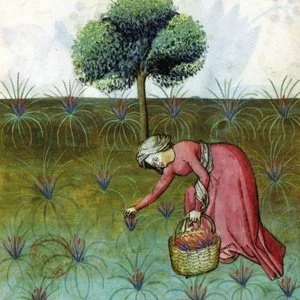
Medieval saffron harvest
Cambridge Colleges and the Saffron Economy
Recent research examining the financial accounts of Cambridge colleges has revealed just how central saffron became to academic life during the late Middle Ages.
Records from colleges including Peterhouse, King's, Pembroke, Queens' and Jesus show saffron appearing regularly in purchases, kitchen accounts, medicinal inventories and even rent payments. In some cases, tenants renting small plots of land from colleges paid part of their rent in saffron rather than cash.
The spice was so valuable that it effectively functioned as a form of currency. College accounts record transactions in which saffron was used to settle debts between institutions.
Far from being an occasional luxury, saffron appeared frequently in college kitchens. Researchers examining medieval account books found evidence that some colleges purchased saffron on a weekly basis. Such regular consumption suggests that saffron had become both a culinary staple and a visible symbol of wealth and status.
For the scholars, fellows and masters who dined at Cambridge's high tables, serving saffron-coloured dishes demonstrated refinement and prosperity. Golden foods were associated with prestige, and saffron offered the most effective way of achieving that prized appearance.
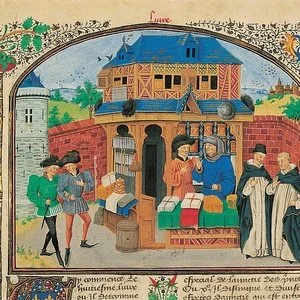
Medieval Wool and cloth trade
Saffron, Wool and the Colour of Prosperity
Saffron's importance in medieval and Tudor England extended far beyond the kitchen and apothecary. It also played a significant role in the country's textile economy, particularly in the dyeing of woollen cloth.
England's wealth during the Middle Ages rested heavily on wool. Vast quantities of raw wool were exported to the cloth-making centres of Flanders, while an increasingly sophisticated domestic textile industry developed in towns across East Anglia, the West Country and the Cotswolds. Colour became an important marker of status and quality, and saffron was among the prized natural dyes available to cloth finishers.
Although not as colourfast as weld or some later imported dyes, saffron produced rich yellow and golden hues that were highly valued for luxury garments, ceremonial clothing and decorative textiles. Medieval dyers often combined saffron with other plant dyes to achieve a range of shades from bright yellow to warm orange-gold. The spice's rarity and expense meant that saffron-dyed fabrics became visible symbols of wealth, much as saffron-coloured foods demonstrated prosperity at the dining table.
The close relationship between saffron cultivation and the wool trade is no coincidence. Many of the regions that grew saffron successfully were already deeply connected to England's commercial networks through wool production and cloth manufacture. Merchants trading in wool, cloth and agricultural commodities frequently handled saffron as part of the same interconnected economy, moving goods between rural producers, market towns, London merchants and continental buyers.
By the fifteenth and sixteenth centuries, saffron had become embedded in England's wider commercial culture. It appeared not only in cookery books and medical texts but also in inventories of dyers, mercers and cloth merchants. The spice occupied a unique position as both an agricultural crop and a luxury commodity whose value crossed the boundaries between food, medicine, trade and fashion.
One of the most enduring reminders of saffron's place in English textile history survives today at the famous London school, Christ's Hospital. Founded in 1552 during the reign of Edward VI, the school is renowned for its distinctive Tudor-style uniform. Among its most recognisable features are the bright yellow stockings worn by pupils, traditionally known as "yellow socks." While modern dyes are now used, the colour recalls an era when saffron and other natural yellow dyes were highly prized and associated with prestige, learning and civic identity. The striking stockings have become one of the most visible surviving echoes of England's long relationship with the golden spice.
Seen in this broader context, saffron was far more than a culinary ingredient. It coloured banquet dishes at Cambridge colleges, flavoured Cornish buns, appeared in medicines and perfumes, and contributed to the vibrant textile culture that helped make England one of medieval Europe's great trading nations. Its story is therefore inseparable from the history of English wool, cloth and commerce itself.
This addition also creates a useful bridge between the Cambridge college economy and the rise of Saffron Walden, reinforcing how saffron sat at the centre of a much larger network of trade, wealth and status.
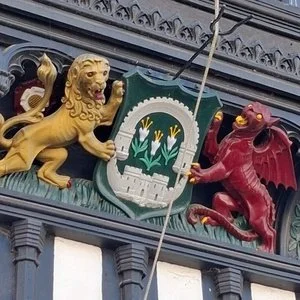
The emblem of Saffron Walden
Saffron Walden: England's Saffron Capital
The demand generated by Cambridge helped transform the local economy.
By the late fourteenth and fifteenth centuries, saffron cultivation had spread throughout the villages south of Cambridge. The market town of Chepyng Walden became the centre of this trade, eventually becoming so closely associated with saffron that it adopted the name Saffron Walden during the Tudor period.
Saffron proved remarkably profitable. Smallholders who had previously grown crops largely for subsistence could now cultivate a high-value commodity for sale to colleges, merchants and traders.
The economic impact was substantial. Saffron from Essex reached London markets and was exported overseas, while local demand from Cambridge colleges helped sustain prices and encourage further cultivation.
Why Saffron Was So Valuable
The answer lies in the harvest.
Each autumn, saffron flowers bloom for only a brief period. The flowers must be picked by hand, often at dawn before they fully open. Workers then painstakingly remove the three delicate stigmas from each flower.
The process is intensely labour-intensive. Contemporary accounts describe harvesters working from dawn until dusk during the short flowering season, sustained by specially brewed strong ale.
Once separated, the stigmas must be dried quickly to preserve their colour, aroma and flavour. Drying reduces their weight by approximately eighty percent, making the finished product even more concentrated and valuable.
Little has changed about this process over the centuries. Modern saffron production still relies largely on the same painstaking manual methods.
Saffron in Tudor Cookery
The golden age of English saffron coincided with the Tudor period.
Tudor cooks used saffron extensively in both sweet and savoury dishes. It appeared in:
Custards and creams
Sweet breads and cakes
Meat pies
Broths and stews
Rice dishes
Festive banquet foods
Beyond flavour, saffron was valued for the brilliant golden colour it imparted to food. At a time when visual display formed an important part of elite dining, saffron allowed cooks to create dishes that reflected wealth and sophistication.
Medical texts of the period also prescribed saffron for a remarkable variety of ailments. It was believed to strengthen the heart, improve digestion, elevate mood and help ward off infection.
During outbreaks of plague, wealthy households sometimes burned saffron or scattered it indoors in the belief that its fragrance could purify the air.
Cornwall's Enduring Saffron Tradition
Although saffron cultivation was concentrated in eastern England, one of the country's most enduring saffron traditions emerged far away in Cornwall.
Cornish saffron buns and saffron cake remain among Britain's most distinctive regional foods. The exact origins of these recipes remain uncertain. Some historians suggest they may reflect long-standing maritime connections between Cornwall and Mediterranean trading networks. Others believe saffron became established through later trade with Spain and North Africa.
Whatever their origins, these recipes represent one of the oldest continuous culinary uses of saffron in Britain. Today, Cornish saffron buns remain a delicious reminder of England's forgotten saffron heritage.

Cornish Saffron Buns
Decline and Revival
England's saffron industry declined during the seventeenth century. Changing fashions, political upheaval and the growing popularity of imported luxuries such as tea, coffee, cocoa and vanilla reduced demand.
At the same time, cheaper imported saffron increasingly outcompeted domestic production.
By the eighteenth century, commercial saffron cultivation had largely disappeared from England.
Yet the story did not end there.
In recent years, interest in English-grown saffron has revived. Small-scale growers across the country are once again cultivating saffron crocuses, reconnecting with a tradition that stretches back more than six centuries.
The use of higher-quality saffron from further afield is also growing, as saffron is once again becoming the Spice of choice and luxury.
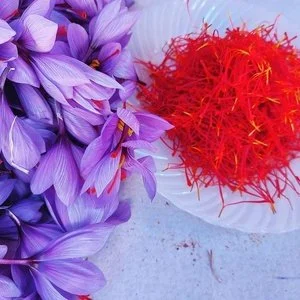
Saffron flowers and threads