
Saffron: The Spice That Followed Civilisation
Few spices can claim a history as long, colourful, and myth-laden as saffron. Long before it flavoured rice, perfumed cakes, or coloured royal robes, saffron occupied a place in religion, medicine, art, and mythology. Its story stretches back thousands of years and follows the rise and fall of civilisations across the Mediterranean, the Middle East, and Europe.
A Spice Older Than History
Evidence suggests that saffron or saffron-based pigments were known to some of the world's earliest cultures. Archaeologists have identified traces of saffron-coloured pigments in prehistoric cave art in what is now Iraq, with some claims dating back as far as 50,000 years. While scholars continue to debate whether the pigment can be definitively identified as saffron, the association demonstrates how deeply rooted the spice is in human history.
Among the most remarkable ancient depictions of saffron are the famous frescoes discovered at Akrotiri on the Greek island of Santorini (ancient Thera). Buried beneath volcanic ash following a catastrophic eruption sometime between about 1600 and 1500 BC, these paintings show women gathering crocus flowers under the watchful eye of a goddess figure. Archaeologists believe the scenes may depict the use of saffron as a medicinal remedy, making them among the earliest known visual records of the spice.
Ancient literature also embraced saffron. Greek mythology linked the flower to the tragic figure Crocus (or Krokos), who was transformed into a crocus flower after death, with the flower's vivid red stigmas symbolising blood, love, or divine transformation. Roman poets, including Ovid, preserved variations of these stories, ensuring saffron's place in the classical imagination.
The spice appears in the Hebrew Song of Solomon, where it is listed among precious perfumes and plants. Ancient Persian, Mesopotamian, Egyptian, Indian, and Chinese cultures all valued saffron for its fragrance, colour, and medicinal qualities. Historical accounts even suggest that Cleopatra incorporated saffron into her beauty rituals and bathing preparations, believing it enhanced both beauty and sensuality.
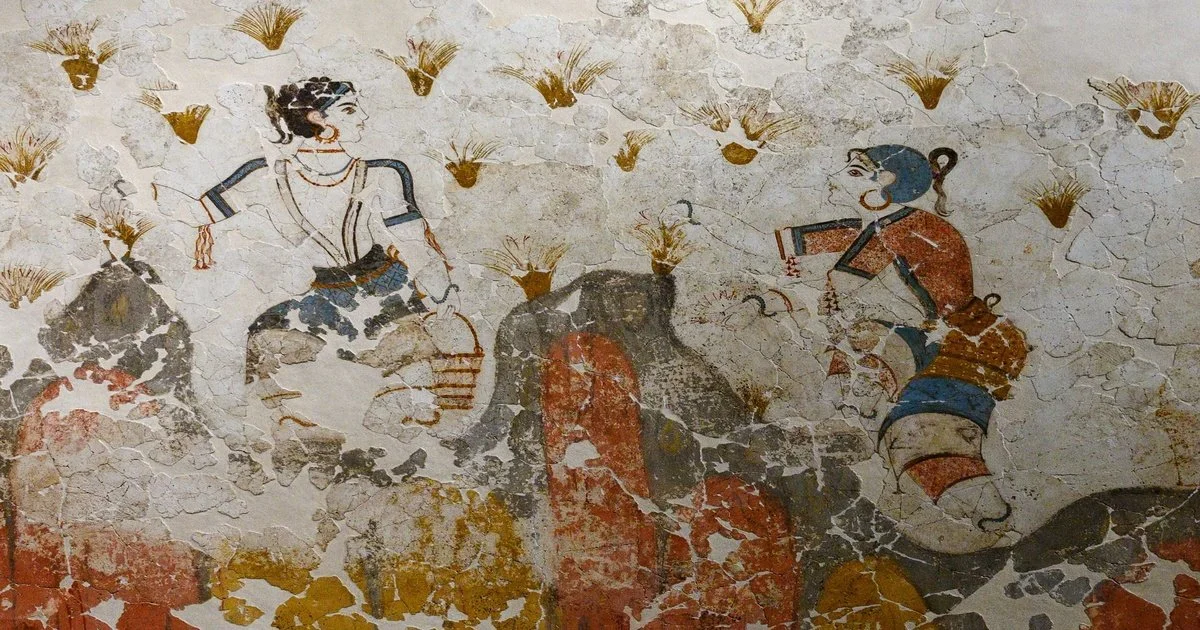
The Saffron Gatherers fresco from Akrotiri, Santorini, depicting Bronze Age women harvesting saffron crocus flowers around 1600 BC Wikimedia Commons
The Romans and the Medieval Revival
The Romans cultivated saffron throughout parts of their empire, including Gaul. Roman aristocrats scattered saffron in theatres, perfumed public spaces with it, and used it extensively in cooking and medicine. Yet after the collapse of the Western Roman Empire, many sophisticated agricultural and culinary traditions declined across Europe, including large-scale saffron cultivation.
Saffron's revival came largely through the Islamic world. Arab and Moorish traders and farmers preserved and expanded knowledge of the spice, introducing improved cultivation techniques throughout North Africa and the Iberian Peninsula between the eighth and tenth centuries. From Muslim Spain, saffron once again spread across Europe, becoming one of the most valuable commodities of the medieval period.
By the fourteenth century, saffron was so prized that it became the subject of international trade disputes. During and after the Black Death, demand surged as physicians prescribed saffron in countless remedies intended to ward off plague or strengthen the body. Whether effective or not, the belief in its medicinal powers drove prices sharply upward.
One of the major centres of the medieval saffron trade was Basel in Switzerland. There, saffron was treated with such seriousness that adulteration could bring severe punishment. Across Europe, merchants attempted to increase profits by mixing genuine saffron with cheaper substitutes such as safflower, turmeric, marigold petals, or dyed fibres. Authorities responded with strict regulations designed to protect both consumers and the reputation of the trade.
Saffron in Britain
England once possessed a thriving saffron industry. The spice grew particularly well in parts of eastern England, especially Essex, Cambridgeshire, and Norfolk. The market town of Saffron Walden in Essex derived both its prosperity and its name from the crop, and the crocus flower still appears on the town's heraldry today.
One of Britain's most distinctive saffron traditions survives in Cornwall through saffron cake, a rich sweet bread flavoured with saffron-infused fruit and spices. Its origins remain uncertain. Some historians suggest that Cornwall's long maritime trading connections may have introduced saffron through Mediterranean merchants. Others point to later trade networks operating through Spain and North Africa.
The romantic theory that Phoenician traders brought saffron directly to Cornwall while purchasing tin remains unproven. Nevertheless, Cornwall's enduring use of saffron is unusual within northern Europe and reflects centuries of commercial and cultural exchange between Britain and the wider Mediterranean world.
The Decline of a Luxury Spice
By the eighteenth century, saffron's dominance had begun to fade. New luxury imports such as vanilla, cocoa, tea, coffee, and sugar transformed European tastes. These products were often easier to transport, less labour-intensive to produce, and increasingly fashionable among wealthy consumers.
As a result, saffron became concentrated in regional cuisines where it had long-standing agricultural roots. Spain's Valencia region continued to use it in dishes such as paella. Southern France retained it in bouillabaisse and Provençal cooking. Northern Italy incorporated it into risotto alla milanese. Elsewhere, saffron gradually became an occasional luxury rather than an everyday ingredient.
The World's Most Labour-Intensive Spice
Part of saffron's enduring mystique lies in the extraordinary effort required to produce it. Each flower of Crocus sativus yields only three delicate red stigmas. These must be harvested by hand, often at dawn, and carefully dried. Tens of thousands of flowers are needed to produce a single kilogram of finished saffron.
Today, Iran dominates global production, supplying roughly 90 percent of the world's saffron harvest. Most cultivation takes place in the arid provinces of Khorasan, where the crop has been grown for centuries.
Other producers include Spain, Greece, India, Afghanistan and notably Morocco.
International development programmes have encouraged Afghan farmers to cultivate saffron as an alternative to opium poppies, with some success. Saffron can be highly profitable and is well suited to the country's climate, although farmers often face economic pressures that make opium cultivation more financially attractive.
A Fragile Future
Despite its ancient pedigree, saffron's future is far from guaranteed. Climate change, water shortages, geopolitical instability, and fluctuating global markets all threaten production. Recent droughts in Iran have already reduced yields and pushed prices higher.
Yet saffron has survived volcanic eruptions, imperial collapses, plagues, wars, and changing fashions. For more than three millennia, this tiny crimson thread has linked farmers, merchants, physicians, cooks, and poets across continents. Few ingredients can tell the story of civilisation quite so vividly.
From Bronze Age frescoes on Santorini to modern kitchens around the world, saffron remains what it has always been: a spice worth its weight in history.